



I'm Jack, and I run Legacy Painting out of Yorktown. Six years in, 800-something jobs done, and I still can't walk past a house with peeling trim without mentally repainting it.
What I actually enjoy is the part most painters skip — sitting down with you, figuring out what you're picturing versus what your walls can handle, and being straight with you about it.
Hampton Roads humidity has ruined more paint jobs than bad technique ever has, so a lot of what I write here comes straight from arguments I've won (and lost) with Virginia weather.
Paint peels in a bathroom ceiling when moisture breaks its bond. How you fix it depends on whether it’s surface flaking, repeat peeling, or a damaged ceiling underneath.
That difference decides everything: the cost, the time, and whether a can of paint helps or just hides the problem for a season. Some ceilings need a weekend. Others need ceiling repair work before a brush touches them.
How bad is it? A three-level check
Paint peeling in bathroom ceiling areas falls into one of three levels. Find yours before buying anything.
| Level | What you see | What it takes |
|---|---|---|
| 1. Surface | A small flake or two near the shower | Scrape, prime, touch up |
| 2. Recurring | Wide patches, or peeling that returns | Full strip, prime, repaint, fix the cause |
| 3. Substrate | Stains, soft or sagging ceiling, mold | Ceiling repair before any paint |
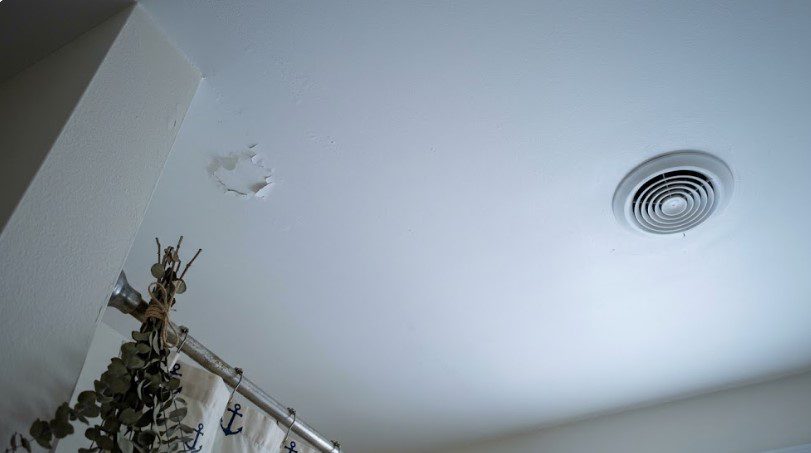
Level 1: surface flaking
One small spot, usually right over the shower or beside the fan. The rest of the paint is firm. This is a DIY job if the home was built after 1978.
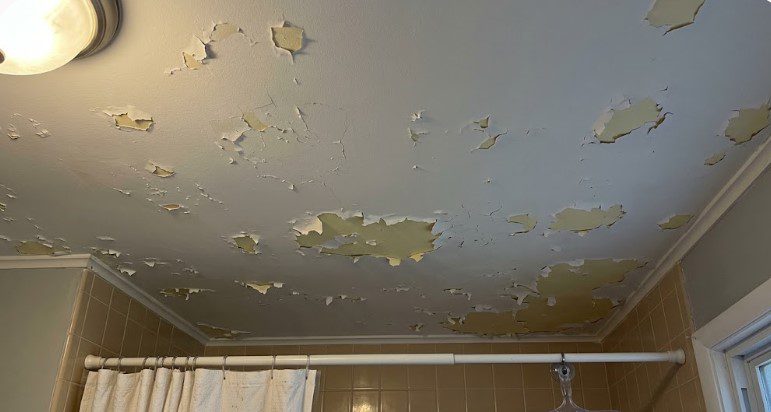
Level 2: widespread or recurring
Paint lifts across large areas, often down to the bare surface. If it has been painted before and came back, it’s Level 2 by default. The cause is almost always ventilation or prep, so a repaint without fixing that will fail again.
Level 3: the ceiling itself is damaged
Brown rings, soft spots, sagging, crumbling plaster, or mold. Paint can’t fix any of these. The ceiling needs repair first, and the source of the water needs to be found.
Peeling, blistering, or flaking?
They look similar from the floor, but each points to a different cause.
| Problem | What it looks like | Usually means |
|---|---|---|
| Peeling | Strips or sheets lifting away | Poor adhesion or prep |
| Blistering | Raised bubbles, sometimes with water inside | Moisture trapped under paint |
| Flaking | Small, brittle chips with cracks | Old, aged paint layers |
Blistering often comes before peeling. Steam pushes behind the paint film, raises a bubble, and the bubble eventually splits open. Catching it at the blister stage makes the repair smaller.
Flaking is most common on very old ceilings with many coats. The layers stop flexing with the house and crack apart.
What breaks the bond
Every cause falls into one of two groups: too much water, or a paint job that was never going to hold.
Water problems
- Steam with no exhaust fan, or a fan too weak for the room
- A fan ducted into the attic, which leaves the moisture inside the house
- A slow leak from a toilet, tub, or roof above
Paint problems
- New paint rolled over a ceiling that was still damp or glossy
- No primer, so the paint had nothing firm to grip
- Flat ceiling paint that soaks up steam instead of shedding it
Most failed bathroom ceilings have one from each group. A weak fan alone may not do it. A weak fan plus unprimed flat paint almost always does.
How to fix peeling paint on a plaster bathroom ceiling
Plaster and drywall fail in different ways, and they need different repairs. Hampton Roads has plenty of both. Yorktown, Williamsburg, and Norfolk all have homes old enough for lath-and-plaster ceilings.
How plaster behaves: it’s harder and heavier than drywall, and it holds moisture longer once wet. It also cracks along the lath lines as the house moves. Old plaster ceilings often carry decades of paint, sometimes including calcimine, a chalky early paint that repels anything rolled over it.
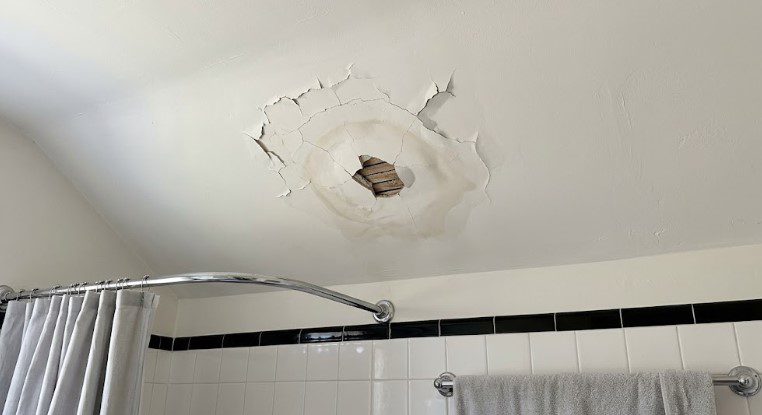
The repair sequence for plaster:
- Test for lead first. Most old plaster ceilings have pre-1978 paint on them. Follow lead-safe work practices: mist before scraping and never dry-sand.
- Check the plaster is still attached. Press gently near the damage. If it moves, it has let go of the lath and needs to be re-secured with plaster washers.
- Remove loose paint and any calcimine. Calcimine washes off with warm water and a sponge.
- Fill cracks and holes with setting-type compound, not lightweight spackle. It’s harder and holds up better on plaster.
- Prime with an oil-based primer. It seals porous plaster and bonds to old paint layers that latex won’t grip.
- Finish with two coats of a quality ceiling paint in a moisture-resistant sheen.
Drywall is simpler. Damaged board can be cut out and replaced in a day. Plaster repair takes more skill to blend, especially where the ceiling has a hand-troweled texture.
Bathroom ceiling water stain and peeling repair, step by step
Water stains and peeling usually show up together. Skip any of these steps and the stain bleeds back through, or the paint lifts again.
- Stop the water. Fix the leak, or confirm the fan vents outside and actually moves air.
- Let the ceiling dry fully. Painting over damp material traps the moisture in.
- Scrape every loose edge, including any lifting tape at drywall seams.
- Re-bed failed tape and patch. Loose tape gets cut out and replaced, not painted over.
- Match the texture so the repair disappears once painted.
- Prime the stain with an oil-based stain-blocker. Cover the whole ring plus a few inches past it. Water-based primers often let tannin stains bleed through.
- Two coats of ceiling paint. Sherwin-Williams ProMar 200 is the standard on these jobs, in eg-shel or semi-gloss for a bathroom.
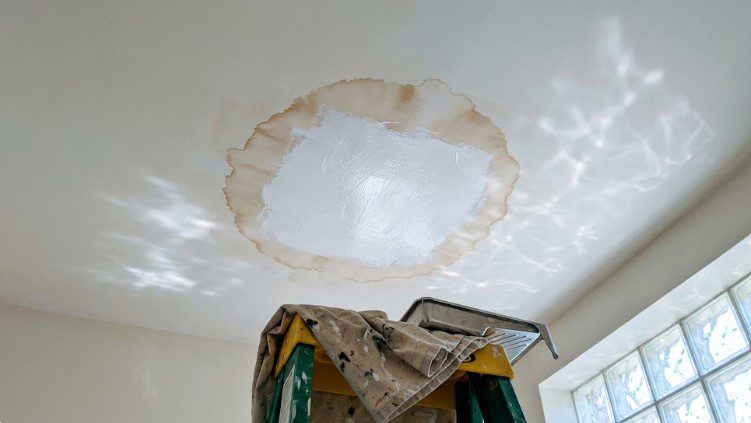
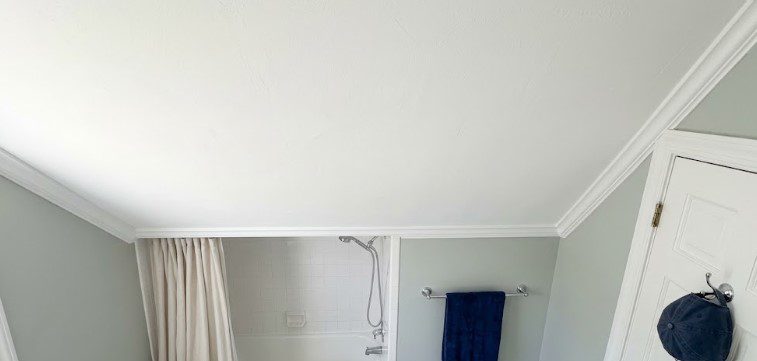
This work carries a 3–5 year warranty that covers peeling and adhesion failure.
Why Hampton Roads bathrooms stay damp, and what helps
Few places swing between weather systems like Hampton Roads. River air off the York and James, and ocean air off the Chesapeake and Atlantic, can both arrive in the same week. Add salt air and long, muggy summers, and a bathroom ceiling rarely gets a fully dry day.
That makes ventilation more important here than almost anywhere:
- Fan size: about 1 CFM per square foot of floor, 50 CFM minimum.
- Venting: ducted outside through the roof or wall, never into the attic.
- Run time: during the shower and around 20 minutes after.
- Airflow: leave the door open a few inches once you’re done.
- Humidity: in muggy months, a dehumidifier or the AC does more than a cracked window, which only lets more damp air in.
Two safety checks before scraping
Lead. Any home built before 1978 may have lead paint under the newer coats. In historic Hampton Roads homes, assume it’s there until a test says otherwise. Mist the surface before scraping, and never dry-sand.
Mold. A few small spots can be cleaned during prep. Large patches, or mold behind soft plaster or drywall, need a remediation professional before any painting starts.
Frequently asked questions
How do I know if my bathroom ceiling needs repair or just repainting?
Press on the damaged area and look for stains. Firm and unstained means a repaint. Soft, sagging, or stained means repair first. Most paint peeling in bathroom ceiling corners is Level 1 or 2 and only needs a repaint.
What primer covers water stains on a ceiling?
An oil-based stain-blocking primer. Water-based primers often let water stains bleed back through the finish coat.
Is peeling different on plaster ceilings?
Yes. Plaster holds moisture longer, cracks along the lath, and may have old calcimine paint that repels new coats. It usually needs an oil-based primer and setting-type compound for repairs.
Peeling or blistering: what’s the difference?
Peeling is paint lifting in strips or sheets, usually from poor adhesion. Blistering is raised bubbles from moisture trapped underneath. Blisters often turn into peeling if left alone.
What does a bathroom ceiling repaint cost?
In Hampton Roads, a typical bathroom runs about $300 to $700. Ceiling repair, plaster work, or stain treatment adds to that.
Can I paint over a water stain without priming?
No. The stain will show through regular paint, often within days. Prime it with a stain-blocker first.
Not sure which level you’re at?
A quick look in person usually settles it. Ceiling repair and painting happen as one job, so a Level 3 ceiling doesn’t mean juggling two contractors.
Assessments are free across Hampton Roads, including Yorktown, Newport News, Williamsburg, Jamestown, Norfolk, and Virginia Beach. Book an assessment to find out what your ceiling really needs.
About the author
Jack Keller leads Legacy Painting in Yorktown, Virginia, serving Hampton Roads homes and businesses since 2015. The team is licensed and insured, works with premium Sherwin-Williams coatings, and specializes in coastal properties and older homes where humidity and salt air are part of every job.